- Effective cleaning uncovers deeper issues but does not solve all problems. Thorough cleaning eliminates residues and coatings, revealing the genuine condition of the stone, including wear, etching, and surface imperfections.
- Restoring dull or uneven floors often requires more than basic cleaning. Factors such as softened surfaces, etching, grout haze, and moisture issues may demand honing, repairs, grout work, or protective measures rather than simply using stronger chemicals.
- Ensuring safe and effective outcomes necessitates a comprehensive evaluation before any action is taken. A specialist will assess the stone type, moisture content, existing coatings, and maintenance history before recommending practical, low-risk restoration and sealing solutions.
Discover the Importance of Stone Floor Cleaning and Its Limitations
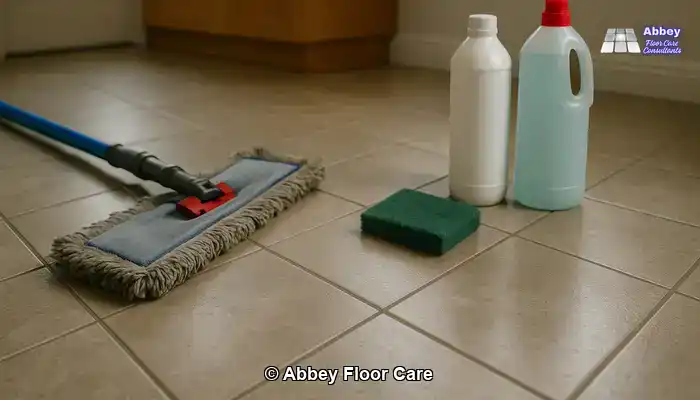
Stone Floor Cleaning Services for Homes in London: Many homeowners in London often feel disheartened when a so-called “deep clean” fails to produce significant visual enhancements in their floors. This reaction is entirely understandable, especially after dedicating considerable time and resources towards the maintenance of something as valuable as stone flooring.
Professional stone floor cleaning transcends the mere application of stronger chemicals or more vigorous scrubbing techniques. It encompasses a systematic approach aimed at eradicating deep contamination, outdated coatings, and residues while honouring the stone’s natural characteristics, rather than forcing it to comply with product labels.
Expert Recommendations: Top Products for Daily Stone Floor Maintenance
|
Fila Pro Floor Cleaner
|
LTP MPG Sealer H20
|
Vileda H2PrO Spin Mop System
|
A key insight that often surprises homeowners is that not every visible issue on a stone floor originates from dirt accumulation. Over time, the upper surface of certain stones, including marble and limestone, can become softened, making them increasingly susceptible to dirt and grime build-up. Moreover, acidic spills can cause permanent etching that no cleaning product can eliminate. Consequently, even after cleaning, the floor may still appear dull or uneven because the surface itself has been compromised.
While cleaning serves a diagnostic function, skilled technicians do not always need to strip away coatings to identify issues. Their expertise enables them to interpret the floor’s condition, recognise signs of distress, and make informed predictions about its appearance following treatment. This approach saves time, avoids unnecessary work, and sets realistic expectations before any coatings are removed.
When a specialist discusses stone floor cleaning, they refer to a meticulously measured, moisture-aware process that not only protects the material but also minimises unnecessary risks while providing a clear, realistic picture of what can be safely achieved.
For further insights, discover how grout cleaning can significantly improve your floors’ overall appearance and longevity.
What Factors Cause Some London Floors to Remain Dull Even After Professional Cleaning?
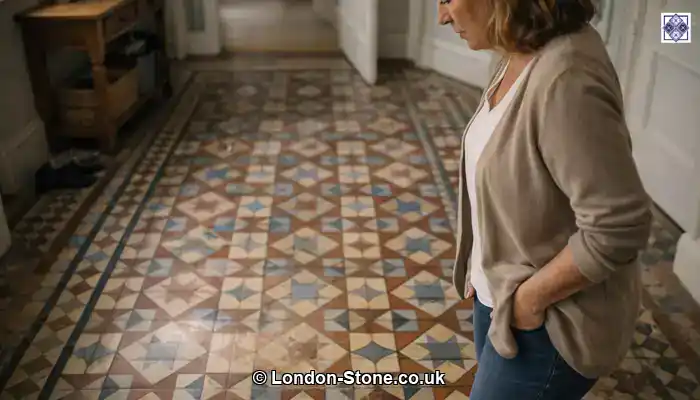
If you have scrubbed, mopped, or even hired professionals to clean your floors, yet they still look lacklustre, it does not necessarily mean that you made an error in your cleaning attempts. More often than not, it indicates that the material has been altered rather than simply contaminated with dirt.
Soft stones that contain calcium carbonate, such as marble and limestone, generally develop a weakened outer layer over time. Continuous exposure to soil, mopping residues, and remnants of previous cleaning agents permeate this outer layer, resulting in a grey, patchy appearance that regular washing cannot rectify. Until this damaged surface is gently refined through controlled honing, the floor will remain flat and lifeless.
Acidic spills, whether from wine, citrus, cleaning solutions, or bathroom products, can lead to visible etching. These light marks are not stains; rather, they indicate that the surface has been chemically eroded in microscopic areas, making them impossible to “clean” away.
In contrast, porcelain and ceramic floors behave distinctly. These tiles are generally dense and non-porous. What might seem like dirt is often grout haze, installation residue, or textured surfaces that trap fine soil particles. Thus, while the tiles themselves may be clean, the surrounding grout can create an illusion of filthiness.
Coated or historic floors present additional challenges. Old wax, acrylic, or unsuitable sealers can trap moisture beneath the surface. In installations lacking a damp-proof membrane, this moisture may migrate upwards, resulting in whitening, cloudy patches, or peeling. Unfortunately, no amount of mopping can resolve these issues until the coating is safely removed.
To understand why some tiles appear blotchy, see this article on ceramic dullness.
Understanding the Levels of Professional Care: From Basic Cleaning to Comprehensive Restoration
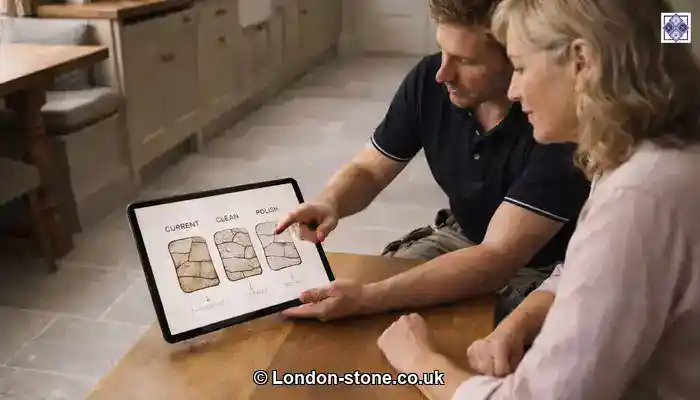
From a homeowner’s perspective, it is entirely reasonable to inquire whether the floor merely requires a thorough cleaning or if it necessitates something more extensive. In practice, the answer to this question becomes clear only after conducting a proper decontamination and inspection.
The following discussion does not represent a mere shopping list of services. Instead, it reflects how a specialist assesses a floor and determines which actions are both safe and suitable.
Level 1: Comprehensive Deep Cleaning and Decontamination Process
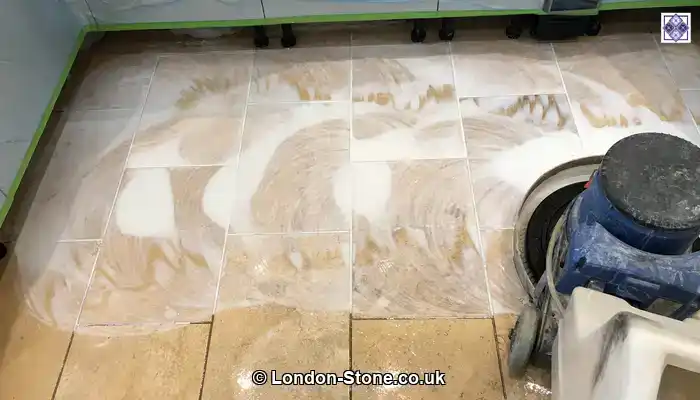
Level 1 focuses on the eradication of deep contamination, failed coatings, and residues, allowing for a precise assessment of the underlying surface. Without this initial stage, all further discussions would merely be speculative.
Cleaning products are meticulously chosen—either high-alkaline or pH-neutral, depending on the specific stone type—and the level of agitation is adjusted to suit the material. Slurry is promptly extracted, followed by multiple rinsing cycles to prevent residue from reabsorbing into the stone’s pores.
For porous stones like terracotta, Victorian tiles, sandstone, and certain limestones, managing moisture is crucial. In the absence of a damp-proof membrane, excess water can draw salts to the surface, resulting in efflorescence. Therefore, careful water control and drying checks are integral to performing the job correctly.
Level 1 can significantly transform many floors, but it cannot reverse wear, eliminate etching, flatten uneven tiles, or repair physical damage.
As a practical consideration, moisture issues often correlate with older installations.
Level 2: Surface Refinement and Honing Techniques for Restoration
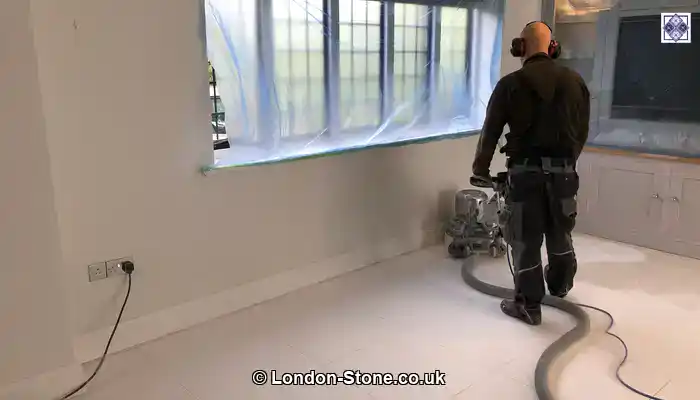
If cleaning reveals dull tracks, etched zones, or softened patches that remain lifeless, controlled honing may be recommended. This technique delicately removes the worn surface, revealing the fresh, sound stone underneath.
For materials such as marble, limestone, terrazzo, and certain smooth slate varieties, honing is typically the standard method for restoring clarity and achieving a natural sheen. The aim is not aggressive grinding but rather careful refinement using abrasives that are suitable for the material and its current condition.
Travertine requires additional caution. Due to its natural voids just beneath a thin outer crust, heavy abrasion can cause deep pits to form. Thus, the goal is to apply only light refinement, followed by filling where necessary.
Level 2 is not suitable for every floor type. Victorian clay tiles, riven slate, and soft terracotta can lose their character or sustain damage if honed too aggressively. In these instances, a specialist will explain why exercising restraint is beneficial to the floor’s long-term integrity.
To explore the differences between finishes, see our guide on marble techniques.
Level 3: Essential Repairs, Filling, and Structural Corrections for Stability
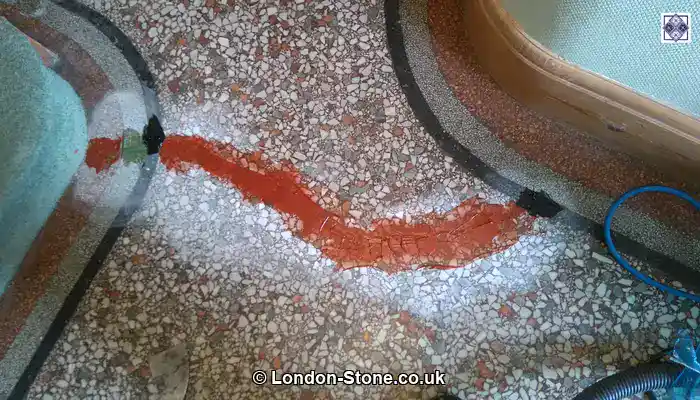
After the surface has been cleaned and refined where applicable, the focus shifts to addressing visible imperfections. The aim is not to achieve perfection but to ensure stability, coherence, and a functional floor for everyday living.
Travertine often benefits from void filling. Newly created pits and long-standing holes can be filled with colour-matched material, reducing dirt traps and enhancing overall aesthetics.
For marble and terrazzo, chips, cracks, and worn channels can be repaired using resin or cementitious fillers. During terrazzo work, a fine grout may be floated over the surface to fill in pinholes before being cut back for a smooth finish.
Grout may also require attention. For porcelain and ceramic floors, tiles rarely fail, but worn, dark grout can dominate the overall aesthetic. Deep cleaning, recolouring, or selective re-grouting can dramatically enhance the final result.
Level 3 does not involve rebuilding the installation. Issues such as structural movement, severe lippage, or subfloor problems are constraints that must be communicated honestly to the homeowner.
For helpful background information, consider that specialist grout repair often plays a significant role in determining the final appearance.
Level 4: Applying Protection and Sealing for Long-Term Longevity
Once the floor is thoroughly cleaned, dried, and in good condition, the final stage is to implement protective measures. The goal is not to make the stone entirely indestructible—since nothing can achieve that—but rather to decrease its absorbency, facilitate easier cleaning, and ensure the floor ages gracefully over time.
Most natural stones and terrazzo are protected using a breathable sealer that penetrates beneath the surface. A high-quality impregnating sealer reduces moisture absorption while allowing trapped moisture to escape, which is essential for many older London floors.
For materials such as Victorian clay tiles, terracotta, and certain types of sandstone, breathable protection is vital. Applying an incorrect topical coating over a damp substrate can trap moisture, leading to whitening or peeling associated with rising damp.
For ceramic and most porcelain tiles, protection focuses primarily on the grout rather than the tiles themselves. Coating the tiles generally leads to residue build-up and increases the required maintenance frequency.
To understand the limitations of sealers, it is crucial to consult a specialist.
Recognising the Critical Limits: What Professional Cleaning Cannot Accomplish
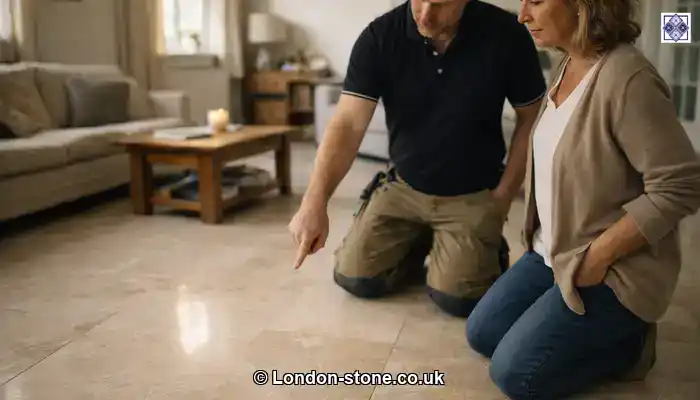
It is entirely natural to hope that a professional visit will restore your flooring to a brand new condition. A responsible specialist will gently clarify where expectations need to be more realistic and grounded.
Deep cleaning cannot undo years of wear and tear. Traffic wear, historical scratches, prior grinding, and moisture issues continue to impact the final appearance, and these cannot be fully remedied through cleaning alone.
No sealer can completely prevent damage. Even the most advanced impregnating sealer will not stop acid etching or scratching caused by dirt underfoot.
Moisture-related issues, including efflorescence, are tied to the building itself rather than solely to the floor. Where damp conditions persist, the focus shifts toward management rather than permanent elimination.
Some stones do not yield a showroom shine. Attempting to force this can lead to greater risks than benefits.
These limitations do not signify weaknesses; they reflect honesty, which often results in better, more sustainable outcomes.
For additional information, see the section on selecting appropriate sealers.
Common Stone Types Found in Residential Properties Across London
London properties display a rich variety of materials originating from various historical periods—often coexisting harmoniously within the same space.
Materials such as marble, limestone, and travertine are frequently found in entrances and kitchens. They exude elegance but require diligent maintenance and, at times, honing.
Period homes often feature Victorian clay, quarry tiles, and terracotta—all of which are aesthetically pleasing yet often installed without damp-proof membranes. Here, breathable protection becomes crucial.
Modern renovations typically favour porcelain and ceramic tiles. Their primary challenges generally revolve around grout haze and worn grout joints, rather than tile failure.
Slate, sandstone, and terrazzo also frequently appear, each presenting unique challenges, from delamination to moisture sensitivity and binder wear.
For a comprehensive overview, explore our guide on advanced restoration methods.
Identifying When a Specialist Assessment is Necessary
There comes a time when adding more products can introduce unnecessary risks. An assessment is advisable when:
- The floor appears dull or patchy despite cleaning efforts.
- Dark, damp-looking areas persist.
- Visible etching or scratches remain unaddressed.
- Coatings appear cloudy or begin to peel.
- Grout remains discoloured regardless of cleaning.
- You are uncertain about the type of stone involved.
A thorough assessment concentrates on gaining insight rather than pushing sales. The technician will identify the material type, moisture patterns, coating history, and likely causes of the issues. Recommendations are made based on this understanding—not the other way around.
To learn how professionals make informed decisions, visit our guide to choosing specialists.
Key Ongoing Care for Your Stone Floor After Restoration
Continued care has a more significant impact than any single restoration visit can provide.
For stone and terrazzo, it is crucial to use only pH-neutral cleaners. Products like bleach, acidic descalers, and potent degreasers can disrupt the maintenance cycle and cause damage to the surface.
Effective dry soil control is equally important. Grit acts like fine sandpaper against the floor, making regular vacuuming essential to mitigate scratches and wear.
For porcelain and ceramic tiles, the focus should be on preventing build-up in grout lines and textured surfaces.
When a topical coating is employed, gentle cleaning becomes even more critical to avoid sticky residues and premature wear.
For straightforward guidance, refer to our list of neutral cleaners.
What to Anticipate in the Future
If your stone floors in London feel burdensome to maintain, appear dull after cleaning, or show concerning marks, the next step should not involve further experimentation but rather a calm, structured assessment.
A specialist will identify the surface type, consider its history, and clarify the appropriate combination of cleaning, honing, repairs, and protection, along with the natural limits of what can be achieved.
If you want your floors assessed with care rather than guesswork, arranging a visit is the simplest next step. You will receive a clear explanation, realistic options, and a plan designed to protect both the material and your investment over the long term.
Frequently Asked Questions Regarding Stone Floor Care
What Causes My Stone Floor to Still Look Dull After Professional Cleaning?
Cleaning effectively removes contamination, old coatings, and residues, yet it cannot restore a worn or damaged surface.
For stones such as marble, limestone, and travertine, the outer layer can soften over time.
Once this layer is compromised, the floor may remain flat or patchy until it is gently refined through controlled honing.
Can Cleaning Eliminate Etching, Scratches, or Traffic Wear?
No, etching is a form of surface damage caused by acids dissolving the stone.
Scratches and traffic wear are types of physical abrasion. While cleaning can reveal these issues,
they typically necessitate specialist honing or repairs—rather than stronger chemicals.
Why Do Porcelain or Ceramic Floors Still Appear Dirty Even When They Are Technically Clean?
Porcelain and ceramic tiles are generally dense and non-porous.
The “dirt” you perceive is often grout haze, installation residue, or soil trapped in textured surfaces and grout joints.
In many cases, the remedy focuses on the grout rather than the tiles.
Do All Stone Floors Require Sealing After Cleaning?
Most natural stones benefit from a breathable impregnating sealer to slow down absorption and facilitate easier maintenance.
However, older floors lacking damp-proof membranes require special attention, as an incorrect coating can trap moisture and cause whitening or peeling.
Porcelain generally does not need sealing, but the grout often requires it.
When Should I Request a Specialist Assessment?
Seeking an assessment is sensible if the floor remains dull after cleaning, shows cloudy or peeling coatings,
has persistent damp-looking patches, or displays etching and scratches that won’t resolve.
A structured inspection will identify the stone type, moisture patterns, and previous treatments before suggesting safe next steps.
The Article Professional Stone Floor Cleaning for London Homes first appeared on https://london-stone.co.uk
The Article Stone Floor Cleaning Services for Homes in London appeared first on https://fabritec.org
The Article Stone Floor Cleaning Services in London for Your Home Was Found On https://limitsofstrategy.com
The Article Stone Floor Cleaning Services for Your London Home found first on https://electroquench.com